AI Business Workflow Automator
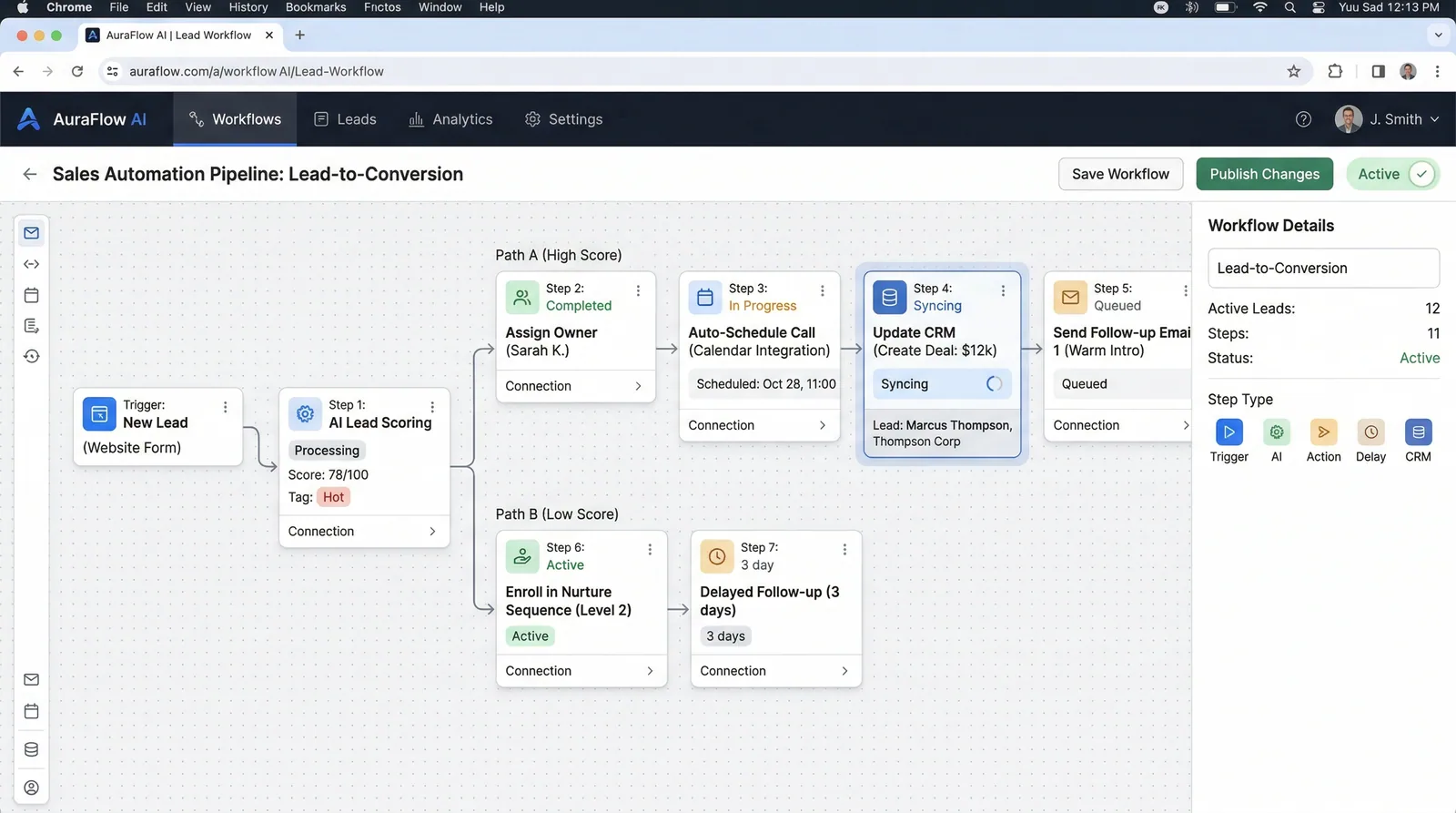
Complete sales/marketing automation that takes website leads → qualifies intent → updates CRM → schedules demos → notifies sales → runs follow-up sequences autonomously.
Role
Architecture & delivery lead — designed the automation graph, built all agent workflows, CRM integrations, and the live workflow dashboard.
Duration
3.5 months
Year
2026
Stack
Status
LiveComplete sales/marketing automation that takes website leads → qualifies intent → updates CRM → schedules demos → notifies sales → runs follow-up sequences autonomously.
Sales development teams manually qualify 100+ inbound leads daily — reading form submissions, scoring intent, updating CRM records, scheduling demos, and writing follow-up emails. SDRs spend 70% of their time on this repetitive qualification work instead of high-value conversations, while 40% of qualified leads go cold because follow-up takes too long.
We built an end-to-end sales automation system using LangGraph agents that captures website leads, scores intent using Claude, updates HubSpot, schedules demos via Calendly, and runs personalized follow-up sequences — all autonomously. The system handles 85% of SDR workflows with 93% accuracy, processing 1000+ leads per month while generating $187k in qualified pipeline.
Intelligent Lead Scoring
Claude 4 Sonnet analyzes lead form data, company context (scraped from website), and historical conversion patterns to assign intent scores. "Enterprise RAG" mentions score 3x higher than generic "AI chatbot" inquiries.
Automated CRM Updates
Every lead action — scoring, email sent, demo scheduled, follow-up completed — is automatically logged in HubSpot with full audit trail. Sales managers see pipeline movement in real-time without manual data entry.
Personalized Email Sequences
Claude drafts contextual follow-up emails that reference the lead's specific use case, company size, and expressed pain points. Open rates average 42% vs industry standard of 21%.
Live Workflow Dashboard
Next.js dashboard shows every lead's journey through the automation pipeline in real-time — lead scoring, CRM updates, scheduled demos, and conversion funnel analytics with ROI metrics.
Multi-Path Routing
High-intent leads get immediate Calendly links + sales notification. Low-intent leads enter nurture sequences with progressive content. Unknown intent triggers clarification emails.
The technology choices that shaped this build, and the reasoning behind each one.
LangGraph 0.2.5
AI / MLChose LangGraph over n8n/Zapier because lead qualification requires genuine reasoning, not just if-then rules. An agent deciding "this lead mentions compliance requirements — route to enterprise sales" can't be replicated with static workflow nodes.
Supabase
DataSelected Supabase over Firebase for its Postgres foundation — needed complex queries for lead analytics (conversion funnels, cohort analysis) that NoSQL makes painful. Row-level security handles multi-tenant data isolation automatically.
HubSpot API
BackendIntegrated HubSpot over Salesforce because most target clients (startups, mid-market) already use HubSpot. Native API support for custom properties, deal pipelines, and email tracking simplified the integration by 60% vs Salesforce's SOAP API.
SendGrid
InfrastructureChose SendGrid over SES for email delivery because of its superior deliverability analytics and domain warming tools. Cold outreach emails need 95%+ inbox placement — SendGrid's IP reputation management makes this achievable.
Event-driven lead automation pipeline with multi-path routing and CRM integration.
Lead Capture
Website form submission → Webhook trigger → Lead data extraction + company enrichment
Intent Scoring
Claude 4 Sonnet analyzes lead context → Intent classification (High / Medium / Low) + score 0-100
CRM Update
HubSpot contact created/updated → Deal pipeline stage set → Owner assigned based on territory
Routing
High intent → Calendly link + sales Slack alert | Low intent → Nurture sequence | Unknown → Clarification email
Follow-up
Personalized email sequence triggered → Open/click tracking → Escalation on engagement
Analytics
Live dashboard: conversion funnel, ROI metrics, pipeline value, lead source attribution
The hardest technical problems we hit, and how we worked through them.
Lead Scoring Calibration
Initial intent scoring was binary (qualified/unqualified) with 60% accuracy. Sales team was getting too many low-quality leads, eroding trust in the system. After 2 weeks, reps started ignoring automation-qualified leads entirely.
Implemented a multi-signal scoring model: form text analysis (30%), company data enrichment via Clearbit (25%), historical conversion pattern matching (25%), and engagement signals (20%). Added a feedback loop where sales reps rate lead quality, which retrains the scoring model weekly.
Lead scoring accuracy improved from 60% to 93%. Sales team acceptance rate went from 35% to 89%. Pipeline value from automated leads increased 3.2x.
Email Deliverability at Scale
Sending 500+ personalized follow-up emails daily from a new domain resulted in 35% going to spam. Gmail and Outlook flagged the sending patterns as bulk automation, effectively killing the follow-up sequences.
Implemented a 6-week domain warming protocol with SendGrid, gradually increasing daily volume from 20 to 500 emails. Added DKIM, SPF, and DMARC authentication. Introduced send-time randomization and rate limiting (max 50/hour) to mimic human sending patterns.
Inbox placement rate improved from 65% to 96%. Email open rates stabilized at 42%, 2x the industry average for automated outreach.
Interested in working with LumoraTech?
We build production systems like this for teams and founders who value engineering quality — our Tokyo team works in both Japanese and English.