OpenClaw-style Personal AI Agent
This autonomous AI agent acts as a digital executive assistant, connecting directly to Slack, Google Calendar, GitHub, and email to handle an entire daily workflow through simple natural language commands.
Role
End-to-end build — we designed the agent graph topology, implemented all 7 sub-agents, built the real-time frontend, and deployed the production infrastructure.
Duration
3 months
Year
2026
Stack
Status
LiveThis autonomous AI agent acts as a digital executive assistant, connecting directly to Slack, Google Calendar, GitHub, and email to handle an entire daily workflow through simple natural language commands.
Executives spend 3+ hours daily on repetitive coordination — scheduling meetings, triaging emails, updating CRMs, and coordinating across platforms. Existing automation tools like Zapier handle simple if-then rules, but can't understand context, prioritize intelligently, or handle multi-step workflows that require judgment and cross-platform coordination.
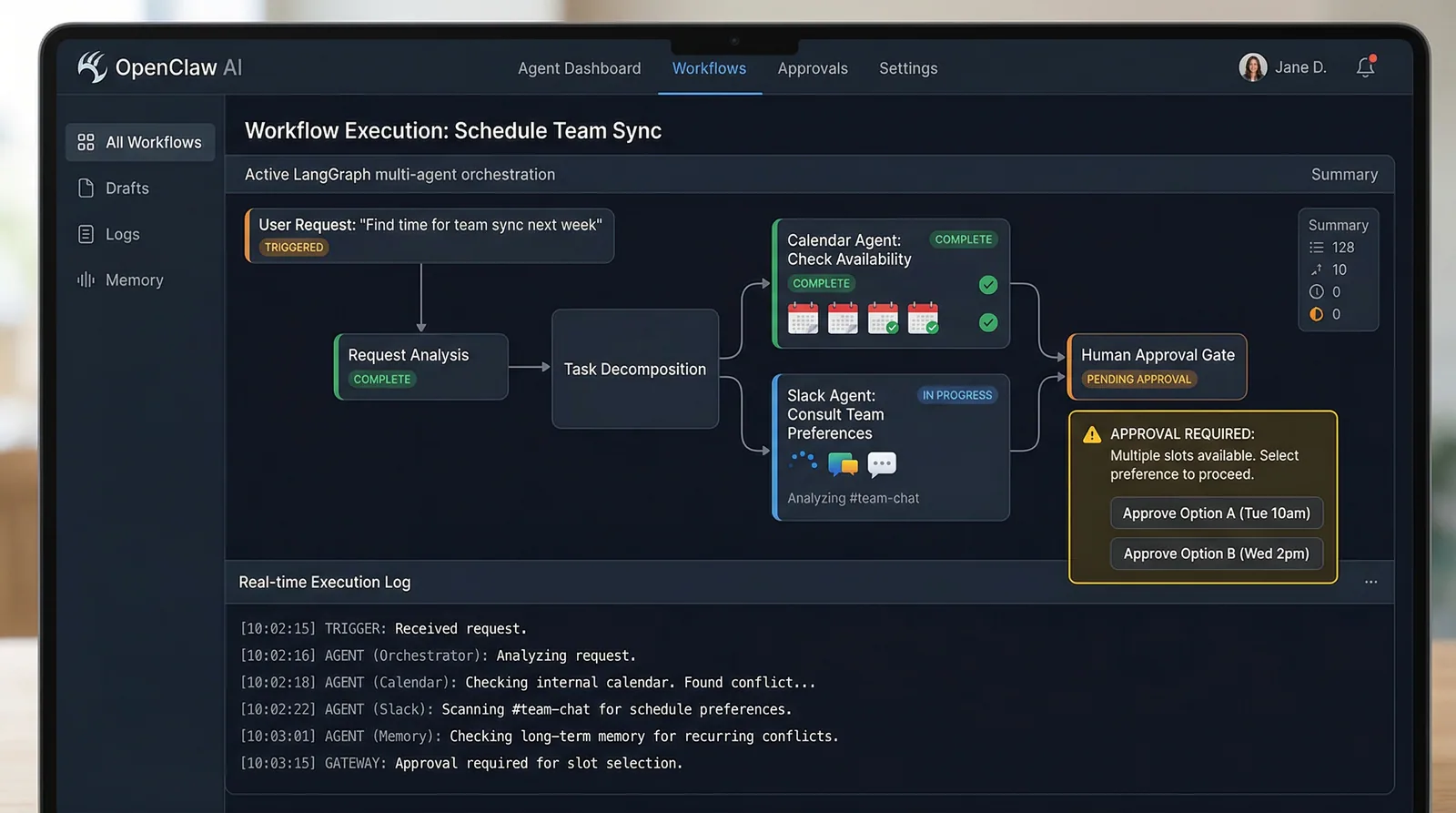
We engineered a hierarchical multi-agent system using LangGraph's supervision graph pattern. A central orchestrator understands natural language, decomposes requests into sub-tasks, and delegates to 7 specialized agents executing in parallel. The system learns user preferences through a persistent memory layer backed by pgvector, and includes human-in-the-loop approval for high-risk actions exceeding $500 or involving code changes.
Hierarchical Agent Orchestration
LangGraph supervision graph coordinates 7 specialized sub-agents (Calendar, Transport, Communication, Code, CRM, Research, Admin) with automatic task decomposition and parallel execution.
Human-in-the-Loop Approval
Configurable approval gates for high-risk actions — transactions over $500, code pushes, and external communications pass through explicit user confirmation before execution.
Persistent User Memory
pgvector-backed preference learning remembers choices like Zoom vs Meet, one airline over another, and preferred meeting times — improving over every interaction.
Real-time Execution Visualization
Live workflow DAG showing each agent's state transitions, execution logs, and approval gates as tasks progress from request to completion.
Multi-Platform Integration
Native connections to Slack, Google Calendar, GitHub, Twilio SMS, and Uber APIs — all orchestrated through a single natural language interface.
The technology choices that shaped this build, and the reasoning behind each one.
LangGraph 0.2.5
AI / MLChose over CrewAI for its explicit state machine model — we needed fine-grained control over agent transitions and human approval gates. CrewAI's implicit delegation made debugging complex workflows nearly impossible.
Claude Sonnet 4.6
AI / MLSelected as the planning LLM for superior instruction-following and structured output reliability. We tested GPT-4o but found it hallucinated tool calls 15% more frequently in multi-step planning scenarios.
Neon Postgres + pgvector
DataChose serverless Postgres over Pinecone for cost efficiency at our scale (<100k vectors). pgvector's tight SQL integration simplified preference queries and reduced infrastructure overhead.
Next.js 15 App Router
FrontendServer Components reduced client-side JS by 40% for the dashboard. Server Actions simplified real-time execution log streaming without needing separate WebSocket infrastructure.
Hierarchical multi-agent orchestration with human-in-loop approval gates and persistent memory.
Input Layer
Voice/Text → Intent Classification via Claude 4 Sonnet
Task Planning
LangGraph Supervisor decomposes request into sub-tasks with dependency graph
Agent Dispatch
Parallel execution across CalendarAgent, TransportAgent, CommunicationAgent, CodeAgent, CRMAgent
Approval Gate
Human-in-loop checkpoint for high-risk actions ($500+, code changes, external comms)
Execution
Approved tasks hit live APIs — Google Calendar, Uber, Twilio, GitHub
Confirmation
Results aggregated → Slack notification + Dashboard update + SMS confirmation
The hardest technical problems we hit, and how we worked through them.
Agent Coordination Deadlocks
When multiple sub-agents needed the same resource (e.g., CalendarAgent and TransportAgent both needing the appointment time), the system would deadlock waiting for shared state, causing 23% of multi-step requests to time out.
Implemented a message-passing architecture with immutable state snapshots. Each agent reads from a frozen snapshot and writes to a merge queue. The supervisor resolves conflicts using priority rules (calendar > transport > notification).
Zero deadlocks in production. Agent coordination latency dropped from 8s to 2.3s average.
LLM Tool Call Reliability
Claude occasionally generated malformed tool call arguments — wrong date formats, missing required fields — causing API failures in 12% of requests during early testing.
Added a PydanticAI validation layer between LLM output and API execution. Invalid tool calls are caught, the error is fed back to the LLM with the schema, and it self-corrects. Maximum 2 retries before human fallback.
Tool call success rate improved from 88% to 99.2%. The retry mechanism adds only 400ms on average.
Interested in working with LumoraTech?
We build production systems like this for teams and founders who value engineering quality — our Tokyo team works in both Japanese and English.